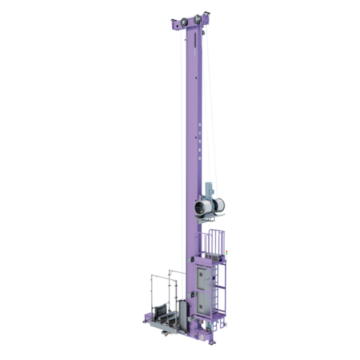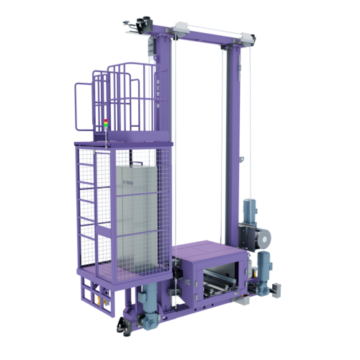
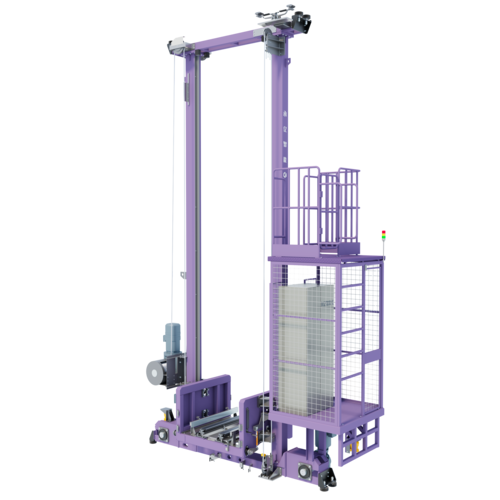
The Miniload stacker crane features numerous advantages such as light weight, low energy consumption, low noise, high speed, and an aesthetically pleasing structure.
A Miniload stacker crane is a fully automated machine used in high-density warehouse systems to store and retrieve small unit loads, such as boxes, trays, or totes. Often referred to simply as a “Miniload,” these cranes operate within narrow aisles of high-bay racking to maximize vertical space and throughput without human operators.
- Compact tote/carton handling: Designed for automated storage and retrieval of small unit loads like bins, totes, or cartons weighing 20–100 kg, ideal for high-density storage in e-commerce, pharmaceuticals, and spare parts warehouses.
- Single-mast efficiency: Utilizes a lightweight single vertical mast with a telescopic extractor or gripper, enabling operation in narrow aisles (0.8–1.2 m wide) and heights up to 12–18 m for optimized space utilization.
- High-speed throughput: Achieves horizontal speeds of 3–5 m/s and vertical speeds of 1–2 m/s, supporting 100–300 cycles per hour per crane to meet fast-paced order fulfillment demands.
- Flexible load devices: Equipped with customizable extractors (e.g., vacuum, clamp, or finger grippers) for handling diverse container shapes and materials, including ESD-safe options for electronics.
- Energy-efficient design: Incorporates regenerative braking and low-friction rails to minimize power usage, often reducing consumption by 20–40% compared to heavier stacker cranes.